
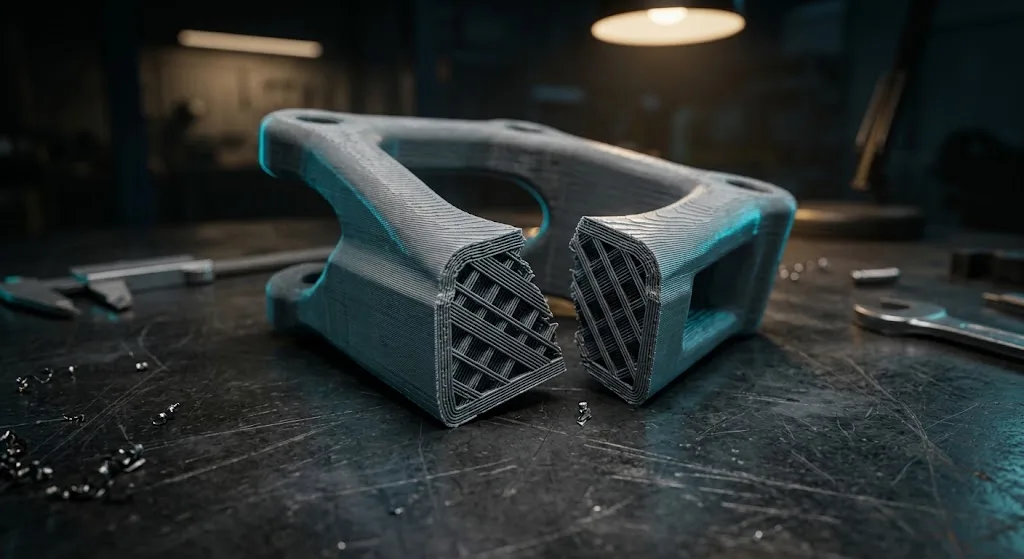
A printed part that looks perfect on screen can still fail to fit. A hole a little too small, a peg a little too large or a lid that does not close – these are the most common frustrations in functional 3D printing. Understanding tolerances is the key to avoiding them. Drukuje3D prints many functional parts every month, and this guide shares practical knowledge about dimensional accuracy, clearances and how to design for a good fit.
FDM printing typically achieves dimensional tolerances in the range of a few tenths of a millimetre. That is excellent for most applications, but it must be taken into account when designing parts that interact with each other.
Why printed dimensions differ
Molten plastic is extruded through a nozzle and cools as it solidifies. The plastic shrinks slightly, the outer edges of layers bulge a little and small holes tend to come out smaller than designed. Material type also matters: different filaments shrink differently. These effects are predictable, so a good design compensates for them.
Recommended design practices
- leave a clearance of a few tenths of a millimetre between mating parts,
- make holes slightly larger than the pins or screws they hold,
- use chamfers on the bottom edges to avoid an “elephant foot”,
- keep wall thickness consistent and not too thin,
- consider drilling or reaming holes that need high precision,
- use heat-set inserts for threads that will be screwed often.
Fit types
A sliding fit allows parts to move freely and requires a larger clearance. A snug fit holds parts together but allows assembly by hand. A press fit requires force and the smallest clearance, which is the hardest to achieve reliably with FDM. For press fits, Drukuje3D strongly recommends a test print.
Test sections
Instead of printing a whole large part to check one critical fit, Drukuje3D can print just a small fragment containing the relevant feature. This is fast, inexpensive and gives certainty before the full print. It is one of the most efficient ways to get functional parts right the first time.
Orientation and accuracy
Printing orientation affects both strength and precision. Holes printed vertically are rounder than those printed horizontally. Layers are weakest when pulled apart, so loaded parts should be oriented to carry stress along the layers. Drukuje3D chooses orientation based on the function of each part. More information about the service is available at https://drukuje3d.com/en/3d-printing-service/.
Layer height and detail
Layer height typically ranges from fine to coarse. Thinner layers improve surface quality and vertical detail, while thicker layers are faster and stronger in some cases. For parts with precise features, finer layers are preferable.
Threads
Large threads can be printed directly, while small threads are better made with metal inserts or tapped after printing. Drukuje3D can advise which solution is best for your part and design.
Summary
Good fit is a matter of design, not luck. With proper clearances, smart orientation and test prints for critical features, Drukuje3D delivers functional parts that assemble correctly and work as intended.